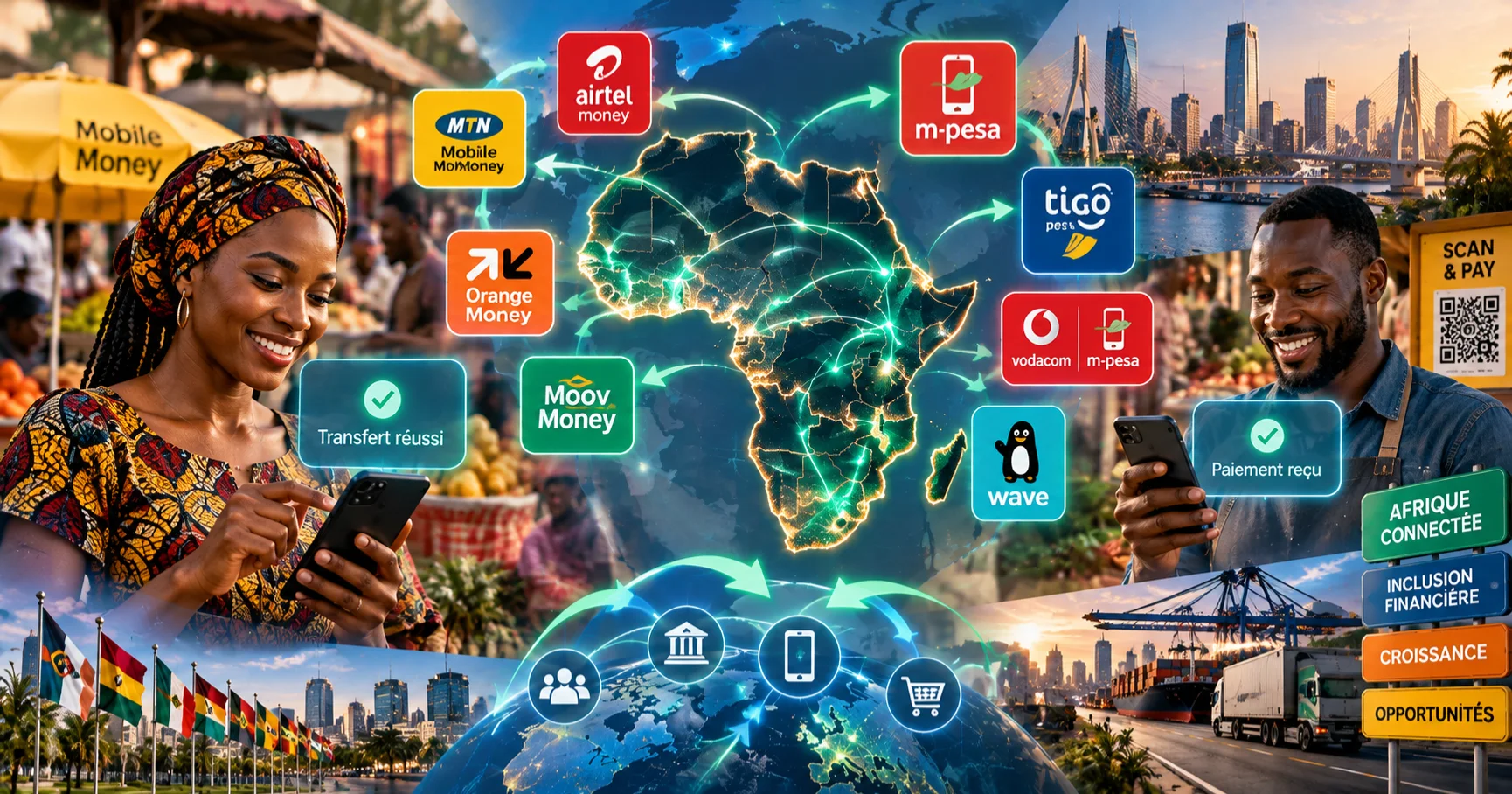
Meanwhile, in Cotonou, Dakar or Kampala, a $70 transfer between an Orange Money wallet and a Moov account clears in seconds. Nobody blinks. That is exactly what should interest us.
Interoperable mobile money as the world's payment lab
We spent twenty years treating Africa as a lagging market. September 2026 says the opposite. Interoperable mobile money has solved, across hundreds of millions of accounts, problems Western banks are only now discovering: lightweight identity, real-time settlement, near-zero marginal cost, and human agents as the last mile.
The mechanism is worth spelling out, because it is not the wallet that matters. It is the clearing layer sitting between operators. When a customer sends value from one network to another, the switch validates the sender against a SIM-linked identity, debits the originating float, credits the receiving float, and settles the net position between operators later, often through a shared settlement account at a commercial bank. The customer sees seconds. The operators see a bilateral obligation they square up in batches. That is a clearing house built for small tickets and thin margins, and it works because the float, not the bank balance, is the unit of account.
The rest of the world is catching up, but in fragments. Block joined the x402 Foundation to standardise payments between autonomous agents, per PYMNTS. CoinDesk reports that Zcash-style privacy could come to Bitcoin without changing its rules. Every brick exists. None of them are assembled.
In Africa, the assembly already happened. A mobile money account is a bank account, a wallet, a settlement channel and a cash-out point in one object. It is ugly, it is fragmented across operators, but it keeps working when wholesale markets shake.
Africa's real innovation was never the mobile wallet: it was making interoperable settlement an everyday assumption while financial centres were still debating the principle.
Who pays for that resilience? Mostly the sender, and mostly in small increments. A cash-out at an agent carries a fee, a cross-network transfer carries another, and the spread between the official rate and the agent's rate carries a third that never appears on a receipt. The cost is regressive in absolute terms and cheap in relative terms: a few cents on a $70 ticket is a rounding error for a salaried worker in Nairobi and a real expense for a market trader in Bamako moving the same amount ten times a week. That is the trade-off regulators keep circling: interoperability lowers the per-transaction price but does not by itself lower the total cost of being poor.
What this week's crypto tape says about rail resilience
Three signals in the same week tell one story.
- Bitget: $388 million gone to a state-linked actor, per the platform's CEO, a reminder that security is not an add-on but the licence to operate.
- The bond shock: Bitcoin absorbed a 5.2% jump in Treasury yields and $1.7 billion in liquidations without a market break, according to CryptoSlate.
- British cash: hoarding of banknotes in the UK, documented by CryptoSlate, shows demand for permissionless money is not fading in a developed economy.
Connect the dots. Demand for direct settlement, with no intermediary able to freeze a balance, is not an emerging-market poverty story. It comes from everywhere, driven by friction fatigue. That is precisely what interoperable mobile money sells without saying so.
Granted, Africa has not solved fraud. SIM swaps, rogue agents and hacked wallets are real. But compare scale: Bitget loses $388 million in one incident, while a mobile money agent network loses a few thousand dollars per local fraud. Risk is distributed, therefore absorbable. A single compromised exchange hot wallet is a systemic event; a thousand compromised agent lines are an operating cost that gets priced into the float and absorbed by the network.
The comparison is not flattering to either side. It is structural. Centralised venues concentrate custody, so a single key compromise drains a balance sheet. Distributed agent networks disperse custody, so losses stay local and the system keeps clearing. Neither model is safe in the abstract. One fails loudly and rarely, the other quietly and often, and the second is easier to insure.
Stablecoins, treasury and competing models
The Binance-Circle deal, analysed by CoinDesk, redraws the stablecoin race. For a small-business treasurer in Abidjan hedging a dollar invoice, the question is no longer crypto or not. It is: which rail costs least between a classic multi-currency account, a stablecoin and a mobile money transfer?
Run the numbers on a $10,000 supplier invoice. A classic multi-currency account might charge a conversion spread of 0.4% to 0.8% plus a fixed wire fee, call it $60 to $110 all in, settled in one to two business days. A stablecoin transfer on a low-fee chain costs a few dollars in network fees plus the on and off ramps at each end, which in most African corridors still means a local exchange or a peer, and the spread there can run 1% to 2%. A mobile money cross-border transfer is the cheapest on paper and the most expensive in practice once you add the cash-out at the destination, because the recipient almost always wants notes, not float.
That is the real contest. Not which rail is fastest, but which rail survives the last mile. Stablecoins win the wholesale leg and lose the retail one. Mobile money wins the retail leg and struggles above a few thousand dollars. A treasurer who needs both ends covered ends up running two rails and paying two sets of fees, which is why the interoperable model keeps winning by default in markets where the alternative is a correspondent bank in Paris.
The answer changes every quarter. That is where the fight will be decided.
What this means for you
- Diversify the rail, not just the currency. Keep a multi-currency account with an IBAN for supplier payments, and a mobile money wallet for local collection. If one goes down, the other runs.
- Treat security as a cost of entry, not an option. Two-factor authentication, withdrawal caps, never the same password on two wallets.
- Watch real fees, not headline fees. A transfer can look like 1.5% and cost 4% after conversion and agent cash-out.
For the detail, our dossier on mobile money breaks down interoperable rails, and the multi-currency account dossier explains how to run both together.
The next inflection point
One number to watch: the $1.7 billion in leverage wiped out in a single session says the next crisis will come from badly housed leverage, not a badly kept mobile wallet. The next decision to watch is regulatory: the announced departure of Hester Peirce from the SEC, reported by CoinDesk, will reshape US doctrine on tokens. On that day, markets that already run interoperable rails in production will hold the advantage. Africa is one of them.
Sources
- Bitcoin Magazine — North Korean Hackers Linked to $388M Bitget Crypto Exchange Theft: CEO (25 September 2026)
- PYMNTS — Block Joins x402 Foundation to Drive Agentic Commerce Standards (25 September 2026)
- CryptoSlate — Bitcoin survives a 5.2% Treasury shock as traders slash $1.7 billion in leverage (25 September 2026)
- CryptoSlate — Why cash hoarding in the UK proves the world still craves permissionless money (26 September 2026)
- CoinDesk — Binance deal gives Circle a boost in stablecoin race with Tether, analysts say (26 September 2026)
- CoinDesk — U.S. SEC's steadiest crypto advocate, Hester Peirce, to depart next week (25 September 2026)