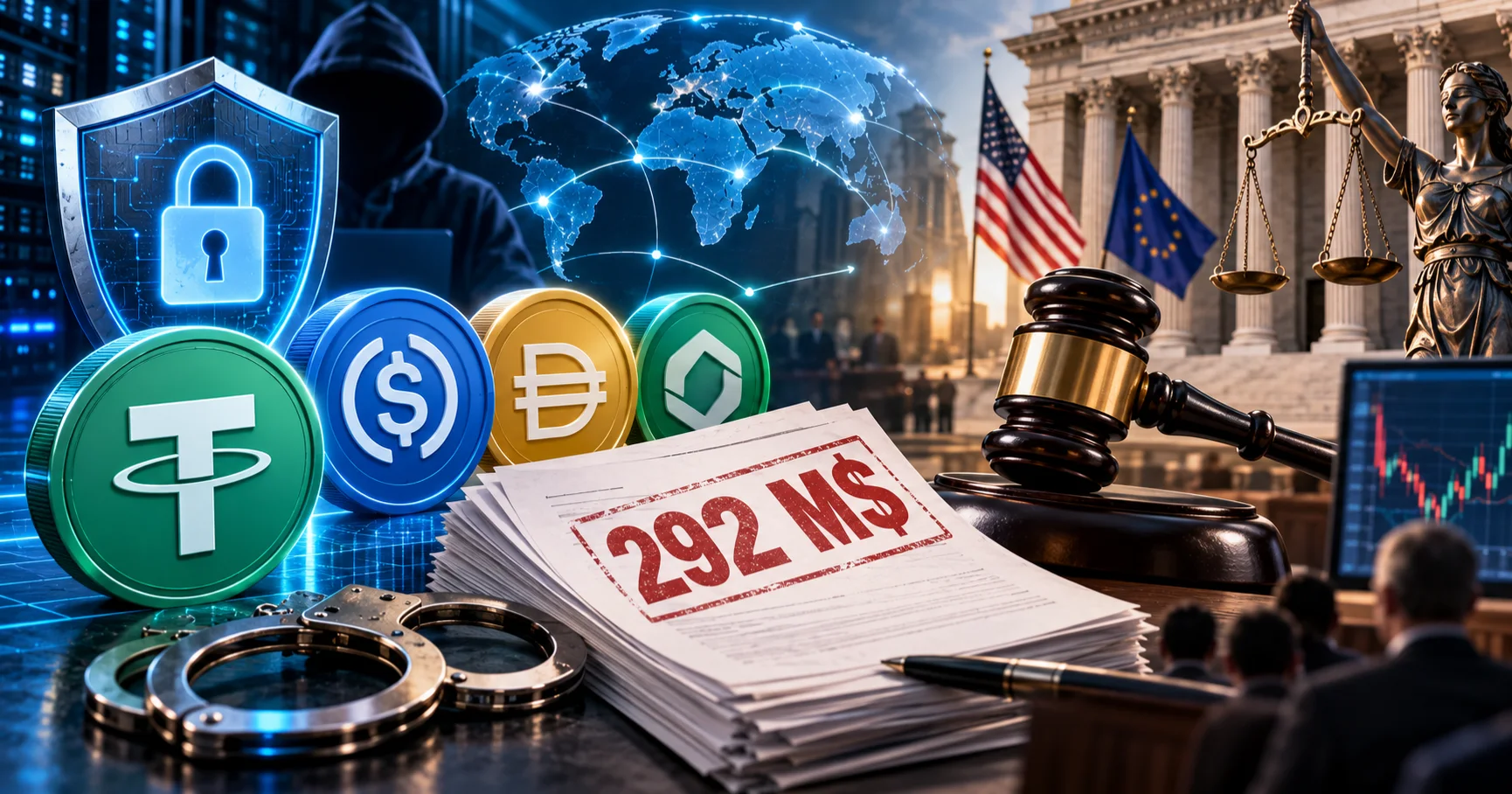
Fifteen billion dollars. That's what left LayerZero in a matter of days, according to CryptoSlate, just as a $292 million lawsuit went after the interoperability protocol's trust architecture. The signal is financial before it is technical: in payment infrastructure, stablecoin security has become an allocation criterion. Treasurers no longer ask whether a rail works. They ask who answers when it breaks.
We'll take a position: security is no longer a cost centre in digital finance. It is the product.
Stablecoin security becomes a selection criterion
The timing is no accident. On 26 September, Circle got a boost through a Binance deal in the stablecoin race against Tether, per CoinDesk. The same day, a Swiss bank said it would shield Bitget's institutional funds while retail withdrawals froze, CryptoSlate reported. Two models, two speeds, one question: who holds your liquidity, and under what terms?
The $15 billion move out of LayerZero isn't panic. It's arbitrage. Teams running digital-asset treasuries now price an exit cost, not just an entry cost. A protocol that can't guarantee reversibility during a dispute loses its trust premium, even if it stays the cheapest option.
Nearly $15 billion switched rails in days, and a $292 million dispute was enough to trigger the move.Look at how the two announcements interact. Circle's win is a distribution story: a listing on the largest exchange by volume widens the float and deepens the order book, which is what a treasury desk actually tests before wiring anything. Bitget's split is a liability story. Institutions got a shield; retail got a queue. Same platform, same week, different answers to the only question that matters when a venue wobbles: can I get my money out, and on what timetable?
That gap is now priced. A treasurer allocating $10 million across two stablecoin rails doesn't compare headline yields alone. She compares the cost of being wrong. If one rail charges 15 basis points more to move but publishes a named custodian, a freeze policy and a documented complaint channel, the extra cost is insurance, not friction. On $10 million held for a quarter, 15 basis points is $3,750. A single frozen withdrawal during a funding round costs far more than that in missed settlement.
What regulators are actually watching
While protocols argue in court, the US regulator keeps moving. On 25 September, the SEC published a crypto FAQ covering token buybacks, network upgrades and promises of profit, according to The Block. The same day, federal prosecutors sought $84.2 million from a bank tied to Tether, per Decrypt.
The message is blunt: compliance is no longer a layer bolted on afterwards. It is designed into the architecture. An issuer that documents reserves, freeze procedures and recourse channels turns a regulatory burden into a commercial argument. Everyone else pays a discount.
The FAQ matters more than it looks. Buybacks, upgrades and profit promises are precisely the grey zones where issuers used to improvise. When the staff writes them down, the improvisation window closes, and the cost of a compliance team shifts from overhead to pricing power. The $84.2 million forfeiture demand runs the same logic through enforcement: a bank in the Tether orbit is being asked to account for flows it once treated as someone else's problem.
There's a personnel angle too. Hester Peirce, the SEC's steadiest crypto advocate, leaves next week, as CoinDesk reported. Her departure doesn't change the FAQ's content, but it changes who defends it internally. Issuers building compliance into the product now have a narrower margin for regulatory error, and less patience waiting for clarity that may arrive later than planned.
Security is no longer what protects the product: it has become the product.
The technical case that reassures treasurers
Three technical shifts deserve your attention, because they move trust from marketing copy into code.
Zcash-style shielded privacy could reach Bitcoin without changing its consensus rules, per CoinDesk. Verifiability improves without breaking the installed base. Conditional transfers are gaining ground: an ARK venture fund tokenised on Ethereum keeps its exit doors locked, CryptoSlate notes. Liquidity, in other words, is bounded by contract. And agent-to-agent commerce is getting standards, with Block joining the x402 Foundation according to PYMNTS. When one machine pays another, identity and spending limits become security features, not options.
Read those three together and a pattern appears. Privacy without a fork, liquidity with a lock, payments with an identity layer. Each one narrows the space where a counterparty can surprise you. That's what a treasurer is buying when she pays up for a rail: fewer surprises, documented in advance.
Granted, security costs money. Cheaper cross-chain bridges will stay attractive for retail-sized flows, and demanding institutional-grade guarantees on every transaction would slow innovation down. That's the serious objection. It only holds on one condition: that the end user knows what they're buying. A cheap rail with no recourse isn't a cheap rail. It's deferred risk.
From custody of assets to custody of reputation
A dormant whale moving $380 million in Bitcoin, flagged by CryptoSlate, is a reminder that liquidity doesn't announce itself. It moves, then we comment. The platforms that survive this cycle are the ones whose security page reads as clearly as their pricing page. On that front, a multi-currency account with an IBAN, escrow and Mobile Money transfers isn't a bundle of features: it's a chain of responsibility. That's exactly what our security and compliance hub documents.
Markets tested that chain twice this week. Bitcoin absorbed a 5.2% Treasury shock while traders cut $1.7 billion in leverage, CryptoSlate reported. A rail that clears through that kind of volatility without freezing withdrawals earns something no marketing budget can buy. Meanwhile, the exits keep widening elsewhere: Warburg reckons GCash's IPO may show Southeast Asia can deliver scale exits, Crowdfund Insider noted. Capital that can leave cleanly is capital that arrives more easily. The same logic runs through a $380 million whale wallet and a $50 remittance: whoever can prove the exit exists gets the deposit.
The week's lesson fits in one line: the $15 billion that left LayerZero didn't flee a protocol, they fled an ambiguity. The next big build isn't transaction speed. It's clarity of recourse.
What this means for you
- Check who holds your money, not just what rate you earn. Two extra points of yield don't offset a vague withdrawal process.
- Test the exit before you enter. Make a small withdrawal the week you open an account or vault, to measure real settlement times.
- Favour rails that publish their freeze and recourse rules: it's the one security criterion you can verify yourself, with no technical background.
One thing to watch: the next hearing in the $292 million dispute, and the first decisions flowing from the SEC's crypto FAQ. Two dates that will tell us whether security stays a selling point or becomes a contractual obligation.
Sources
- CryptoSlate — Nearly $15B is moving off LayerZero, now a $292M lawsuit puts its security model on trial (26 September 2026)
- CoinDesk — Binance deal gives Circle a boost in stablecoin race with Tether, analysts say (26 September 2026)
- CryptoSlate — Swiss bank shields Bitget institutions while retail funds freeze (26 September 2026)
- The Block — SEC crypto FAQ addresses token buybacks, network upgrades and promises of profit (25 September 2026)
- Decrypt — US Prosecutors Want $84.2 Million From a Bank Tied to Tether (25 September 2026)
- CoinDesk — Bitcoin could soon get Zcash-style 'shielded' privacy without changing its rules (26 September 2026)
- CryptoSlate — ARK partners with Securitize to put a venture fund on Ethereum, but leaves exit doors locked (26 September 2026)
- PYMNTS — Block Joins x402 Foundation to Drive Agentic Commerce Standards (25 September 2026)
- CryptoSlate — Dormant whale moves $380M Bitcoin, leaving the sale question unanswered (25 September 2026)