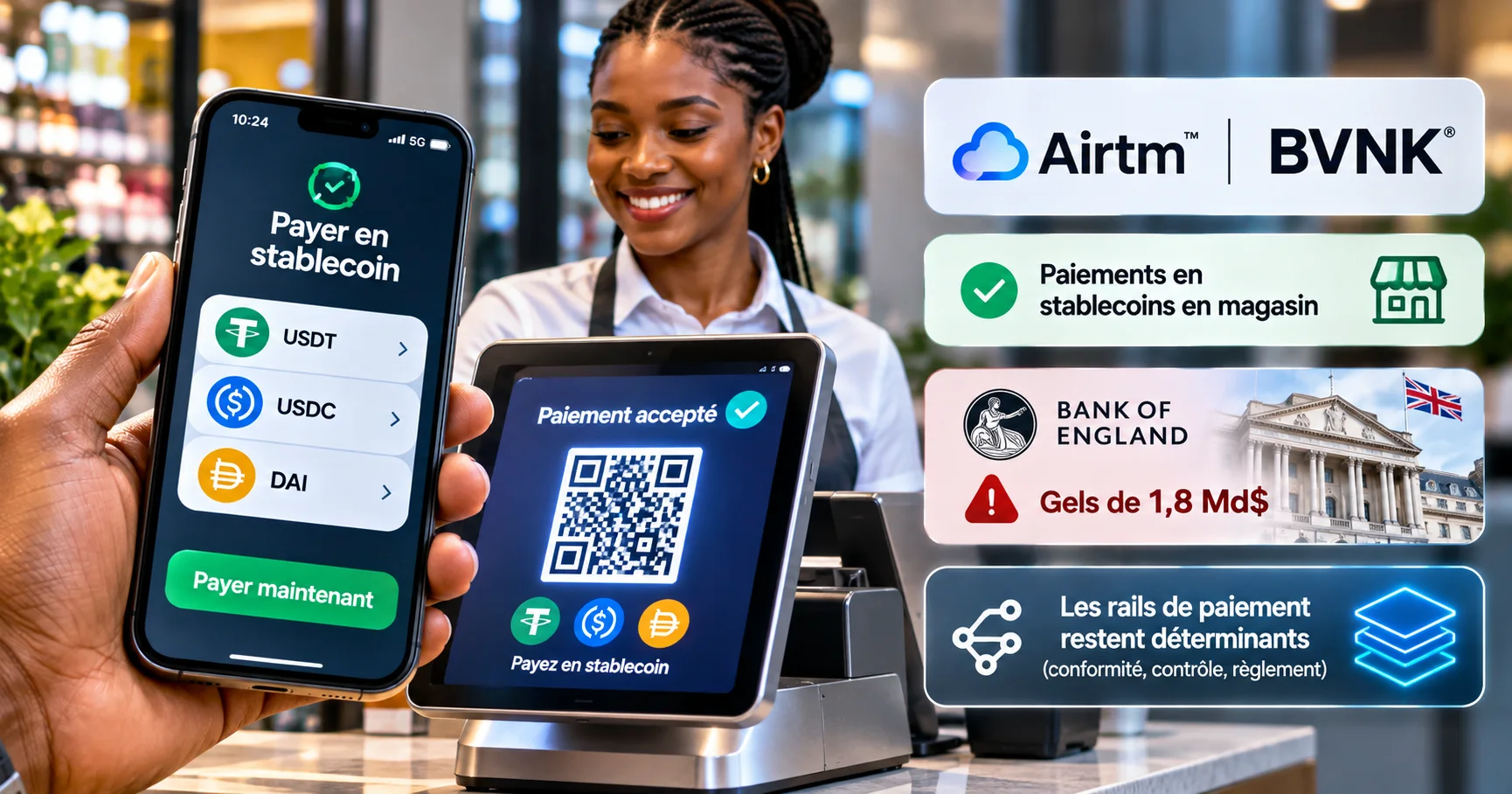
On 30 October, Airtm and BVNK announced something that reads almost mundane: Airtm wallet holders will be able to pay at retailers without routing through an exchange or converting to local currency first. The short note hides a shift. The stablecoin stops being a refuge for traders and becomes a way to pay at the till. That's where stablecoin wallet payments leave the demo and enter daily life.
Our argument runs against the prevailing narrative: the weak link in stablecoins is no longer the money. It's the path between the wallet and the checkout. The winners won't be the loudest issuers. They'll be the players who own conversion, key custody and compliance.
Why stablecoin wallet payments change the maths
Until now, someone holding USDT or USDC who wanted a coffee had to stack three moves: sell, withdraw to a bank, then pay. Each step burns time and fees. The Airtm-BVNK tie-up reported by Fintechnews collapses the stack. The stablecoin balance becomes directly spendable at the merchant, who settles in their own currency without ever knowing a token moved.
That's the durable promise: a digital dollar that travels at near-zero cost, around the clock, Sundays included. For a worker sending money home or a freelancer paid in a foreign currency, that matters more than any slogan about disintermediation.
The quiet signal from the Bank of England
The same day, the Bank of England set out how it will treat tokenised collateral in central clearing. The announcement is dry. It's also more consequential than ten crypto card launches. When a central bank accepts that tokenised assets can serve as collateral inside settlement systems, it concedes that tokenisation belongs in the financial plumbing, not just in retail wallets.
The message is consistent: regulators are no longer fighting tokenisation, they're framing it. That shift helps payment use cases, provided the private side delivers on security.
The risk nobody wants to price
There's a reverse side. According to OneSafe's review of Web3 payments, the ecosystem has absorbed $1.8 billion in frozen assets and $5.6 billion in breach-related losses. A frozen stablecoin is a balance that still shows on screen and won't move. For a merchant, that's a dead receivable. For an individual, it's a blocked rent payment.
$1.8 billion in stablecoin assets frozen, and $5.6 billion lost to Web3 breaches, per OneSafe.That's why the key-custody question isn't ideological. It's accounting. A non-custodial wallet makes you sovereign and leaves you alone with a mistyped address or a malicious contract. A custodial service protects you from yourself and exposes you to its freezes and its decisions. The right answer isn't philosophical. It's operational.
What Russia reveals about the front door
The Bank of Russia has cleared 17 crypto exchangers while Sberbank and VTB prepare retail offerings, according to DL News. You can argue about the politics; the market signal is plain. Where the state opens a regulated counter, demand migrates from opaque peer-to-peer channels to identified entry points.
The lesson travels: fiat-to-crypto conversion should be a service with a posted price and a complaints route. Not a Telegram group. A user should be able to buy, sell and swap without guessing who holds the keys at the other end. The exchange services and conversion routes people actually use are the ones that make that path legible.
The stablecoin no longer needs defending; it's the journey from your balance to the merchant that needs rebuilding.
The missing link: compliance at the user's end
Meanwhile, US regulators keep chasing fabricated confidence. The SEC charged two entities over a $130 million scheme built on false regulatory filings. The fraud didn't happen on a blockchain. It happened in manufactured trust. That's exactly where crypto wallets must be beyond reproach: proof of reserves, traceable flows, identity checks at the sensitive points.
Users aren't asking for a manifesto. They want to top up an account, pay, send and receive without handing their keys to a stranger. We track those use cases in our file on crypto and stablecoins. Key sovereignty only earns its keep when it comes with a clean conversion path.
Granted, the custodial model has real advantages: recovery, dispute handling, insurance in some cases. Most people will never secure a seed phrase properly, and pretending otherwise is condescending. But custody should be a choice you make knowingly, not the default you fall into because the alternative requires a manual.
What this means for you
- Check who holds the keys and what triggers a freeze. A stablecoin issued by a centralised actor can be blocked by that issuer. Before parking emergency savings there, ask what the blocking conditions and the appeals process are.
- Separate spending money from savings. Keep a small stablecoin balance for payments and transfers, and leave the bulk of your funds somewhere that doesn't depend on a single issuer. Payment convenience doesn't require immobilising all your capital.
- Look at total cost, not the headline fee. Conversion, withdrawal and spread are three lines that add up. A "free" stablecoin payment can cost more than a bank transfer if the conversion is badly priced. Compare on what the merchant or your family actually receives.
The next test lands in November, when the first tokenised collateral transactions clear under the Bank of England's watch. Settle without incident, and the stablecoin earns institutional credibility. Let a major freeze hit at the same moment, and trust will lag the technology. Watch that calendar, not the bitcoin price.
Sources
- Fintechnews Europe — Airtm and BVNK Partner to Let Wallet Users Pay at Retailers (30 October 2026)
- OneSafe
- DL News — Bank of Russia clears 17 crypto exchangers as Sberbank and VTB ready retail trading (22 October 2026)
- SEC — Two Entities Charged in $130 Million Fraud Scheme That Used False SEC Filings to Boost Investor Confidence (29 October 2026)