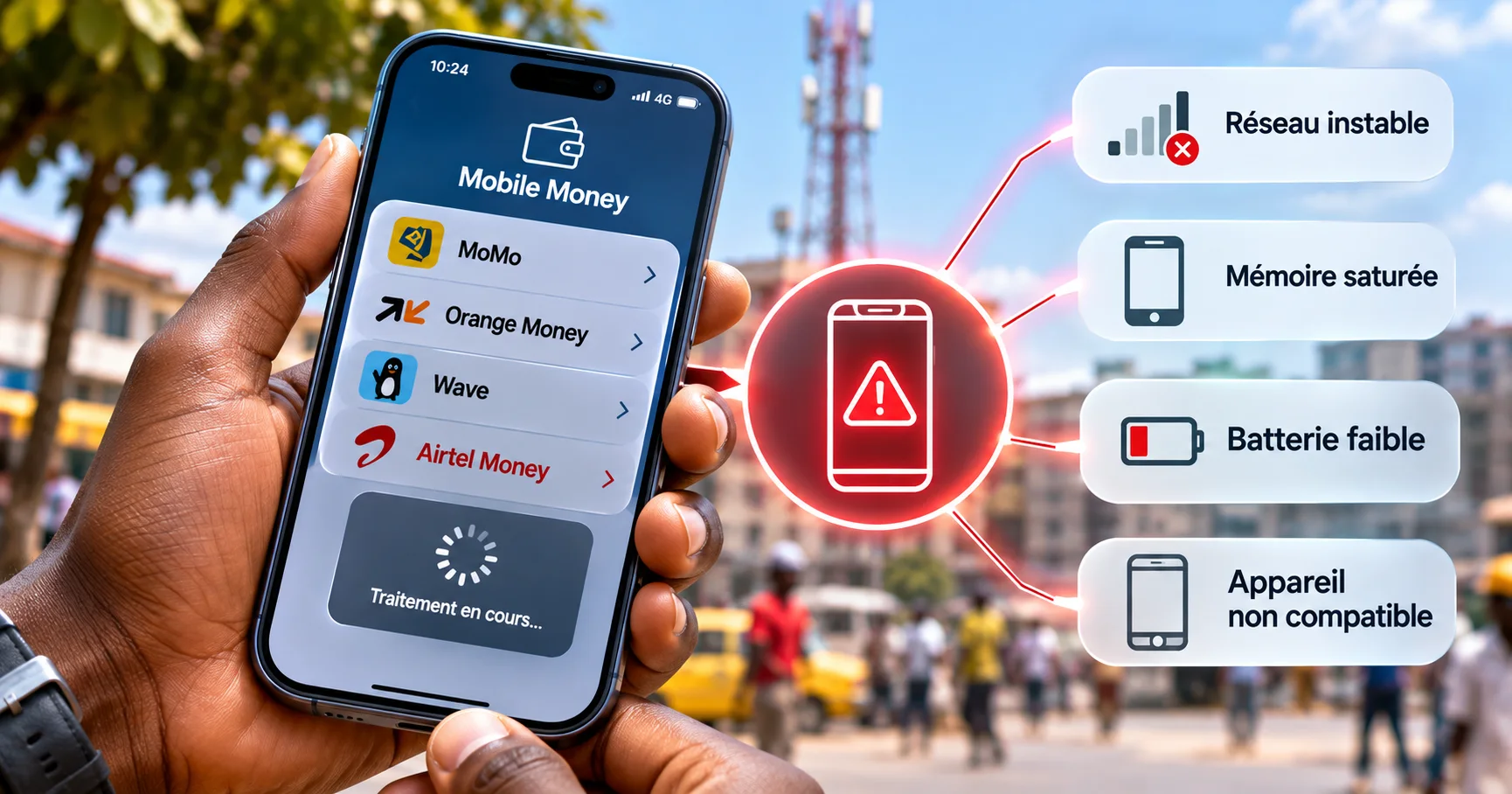
Gabon has the towers. It has the fibre, the 4G, the coverage maps that look reassuring in a ministry presentation. And yet more than half the population still sits outside mobile internet, according to the GSMA. The blockage isn't technical. It fits in a pocket: the one where an $80 handset never lands.
That's the lesson the mobile money industry has spent a decade failing to absorb. We built admirable rails, interoperable wallets, instant corridors. We forgot to check who could actually board.
Mobile money: the gap between network coverage and real usage
The distinction sounds academic. It isn't. A tower covers kilometres; a phone covers one person, and only if that person can afford it.
The GSMA said it plainly on 29 October: across sub-Saharan Africa, device affordability remains the single biggest barrier to connectivity. Gabon isn't an outlier, it's a stress test. A middle-income country with decent infrastructure, where half the population can't reach mobile services for want of a handset.
That shifts the argument. For years regulators and operators measured network penetration. The number that matters now is smartphone ownership among people who could plausibly use a financial app.
More than half of Gabon's population remains offline from mobile internet despite national network coverage, per the GSMA.Why financial inclusion hinges on handset prices
A free account is worthless without a device to open it on. That sounds trivial until you notice how much of modern finance now lives in an app: savings vaults, currency conversion, escrow, digital savings circles.
The paradox is sharp. The markets where mobile money matters most are the ones where a smartphone eats the largest share of income. Eighty dollars is several weeks of median wages across much of the region. The barrier isn't data bundles. It's hardware.
Hence the GSMA's push for cheaper devices, through tax treatment, instalment financing, and entry-level models that are actually usable. This is an industrial problem as much as a financial one. And it largely sits outside the reach of fintechs, who don't manufacture phones.
A payment rail includes nobody. The handset is what walks a person into the system.
What the Financial Inclusion Compass 2026 shows
The diagnosis converges. In its reading of the Financial Inclusion Compass 2026, NextBillion describes a sector past its easy phase: growth no longer comes from adding users, but from deepening usage. Which means serving poorer, more rural, harder-to-reach customers with business models that hold together.
The report calls them harder choices. That's generous. Inclusion is entering a phase where each new customer costs more to acquire, compliance weighs heavier, and funders want evidence of impact rather than headcount.
There's a structural upside, though. The markets that got mobile money right did it with light models: local agents, simple interfaces, transparent pricing. Not heavy apps demanding premium hardware. Handset scarcity pushes the industry toward technical restraint, not away from it.
Interoperability: a laboratory the rest of the world should study
Here's the question the industry dodges: what good is connecting networks if a chunk of customers can't plug in?
Two answers. First, interoperability still pays: it cuts the cost of sending money for those already connected, and that cost is genuinely falling. Second, it forces operators to compete on service rather than on a closed network's exclusivity.
This is where Africa functions as a global laboratory, mostly unacknowledged. The problems solved here, from expensive devices to fragmented identity to agent coverage in rural areas, are the ones emerging markets in Asia and Latin America will face next. The playbook tested on the continent, including low-cost cross-border transfers and lightweight multi-currency wallets, is already travelling.
Granted, the optimists have a point: mobile money has done more for financial inclusion than three decades of conventional banking policy. Hundreds of millions of accounts, safer savings, women managing income without a gatekeeper. That record isn't in dispute.
But it has hit a ceiling. And the ceiling isn't financial. It's physical.
What this means for you
- Judge a service by your phone, not by the brochure. A light multi-currency wallet that runs on an entry-level handset and a patchy connection will serve you better than an elegant app reserved for flagships.
- Watch the exchange rate, not just the fee. When transfer fees fall, margin often migrates into the rate applied. Compare what arrives, never what leaves.
- Check the corridor before you send. Interoperable routes are multiplying; a payment routed through two networks pays two sets of charges.
The next milestone is a specific number: the floor price of a connected smartphone in sub-Saharan Africa. The GSMA is arguing for devices below $50. Manufacturers, governments and operators each own a piece of that problem. By year-end we'll know whether tax announcements follow the rhetoric. That, not another fintech conference panel, is where the next billion accounts get decided.