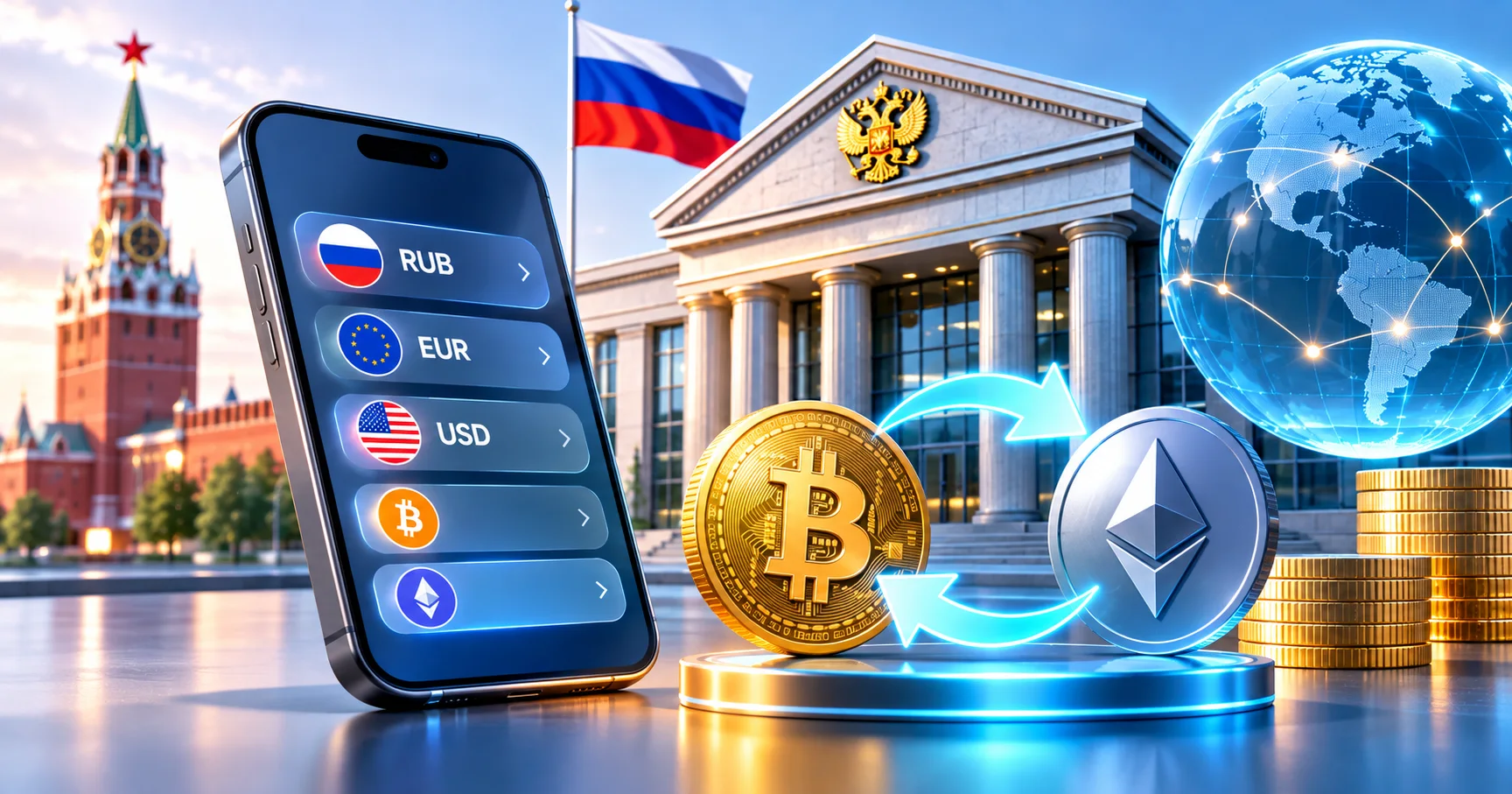
On 22 October, the Bank of Russia published a list of 17 licensed crypto exchange desks. The same day, Sberbank and VTB said they were preparing retail trading offers, as DL News reported. That isn't really a market regulation story. It's a redesign of the counter.
Currency conversion, long pushed into back rooms and messaging apps, is being moved into the bank branch, with a window, rules and a statement. For anyone holding a multi-currency account, the shift matters more than it looks: it moves the question from what bitcoin costs to where you convert, and what you can prove afterwards.
What Russia is actually regulating: exchange, not speculation
Reading the decision as a green light for crypto bets would be a mistake. Seventeen approved intermediaries is a narrow perimeter, built to channel flows that already existed. The message is administrative: converting one currency into another becomes a traceable operation, attached to an identified institution.
That changes the nature of the risk. In an unregulated exchange, you agree a rate inside a conversation, with no recourse and no timestamp. In a regulated one, you probably pay more, but you get a record you can use. The price of trust, essentially.
Granted, the framework says nothing about the rate itself. A licensed desk is still free to set its margins. Russia is formalising the pipe, not the price.
There's a second, quieter effect. Licensing concentrates volume in a handful of desks, and concentrated volume is easier to supervise but harder to shop around. A user who once compared five Telegram sellers now compares two or three bank rate cards. That's an improvement in recourse and a loss in price discovery, and the two don't cancel out. The Bank of Russia has chosen which one it values more.
The real cost of a multi-currency account sits behind the headline rate
This is where public debate aims at the wrong target. People compare advertised rates and forget the spread, the fixed fee and the delay. A 0.4% margin on 2,000 euros costs 8 euros; a "free" conversion with a 2% spread costs 40. The difference never appears in the advert. It appears in the balance.
The Bank of England has just set out its approach to tokenised collateral in central clearing, according to the Bank of England. That sounds remote. It isn't: it confirms that exchange infrastructure is being rebuilt around shared ledgers, where conversion and settlement collapse into one step. Fewer steps should mean fewer hidden costs, in theory.
In theory, because the savings only reach the end user if the intermediary passes them on. A bank that settles in one step still bills for the step it no longer takes, at least until a competitor undercuts it. That's the part of the Russia experiment worth watching: not whether Sberbank and VTB can trade crypto, but whether their published terms are cheaper than the informal desks they're replacing.
17 licensed crypto desks in Russia, against millions of users on undeclared wallets: that is the balance of power the Bank of Russia is trying to reverse.Exchange was never free: it was merely invisible, until a regulator made it legible.
The quiet inflation of corridors, seen from the ground
While Moscow builds its counters, the underlying question for any household receiving money from abroad stays the same: how much actually lands? The GSMA notes that more than half of Gabon's population remains off mobile internet despite existing network coverage, per the GSMA release. The bottleneck isn't the mast. It's the handset.
That detail says something larger. You can open sophisticated exchange rails and still leave people outside, for want of a 60-dollar phone. Cross-border purchasing power isn't eroded by rates alone; it is eroded by access to the tool that applies the rate.
Run the numbers on a remittance. A sender abroad wires 200 euros home each month. At a 1.5% all-in cost, 197 euros arrive. At 4%, the kind of margin that survives in thin corridors with few competitors, 192 euros arrive. Over a year that's 60 euros gone, roughly the price of the handset that would have let the recipient compare rates in the first place. The fee and the access gap compound each other.
The Financial Inclusion Compass 2026 points the same way: inclusion players face harder trade-offs between compliance costs and reaching rural populations. In practice, the least profitable corridors are the first to absorb a margin increase.
What this means for you
- Watch the margin, not the rate. Ask for the reference rate and the applied rate; the gap, multiplied by the amount, is your true cost of exchange.
- Choose exchange that leaves a paper trail. A dated statement beats a screenshot of a chat, especially when you must justify the source of funds.
- Split your conversions. Converting in staggered slices avoids one single entry point, without pretending to forecast the market.
A well-kept multi-currency account isn't a betting tool. It's an accounting tool. Belook's multi-currency account hub explains how to separate balances by currency and track conversions, which makes the margin visible instead of guessed.
The date to watch: the first published rate cards
What matters isn't the announcement. It's the fee schedule. When Sberbank and VTB publish retail trading terms, we'll know whether Russia's framework produces cheaper exchange or merely cleaner exchange. If the advertised margins exceed those of unlicensed desks, the lesson will travel across every corridor: traceability has a price, and the user pays it.
The comparison cuts both ways. Should the licensed desks undercut the informal market, other regulators will have a template: license a small number of intermediaries, force the flow through them, and let competition do the pricing. Should they not, the 17 licences become a toll booth rather than a market, and users will drift back to the channels the Bank of Russia was trying to close.
The coming weeks will show which model gets copied.
Sources
- DL News — Bank of Russia clears 17 crypto exchangers as Sberbank and VTB ready retail trading (22 October 2026)
- GSMA — GSMA Calls for More Affordable Smartphones as Over Half of Gabon’s Population Remains Off Mobile Internet Despite Network Coverage (29 October 2026)
- NextBillion — Harder Choices Ahead: What the Financial Inclusion Compass 2026 Tells us About the Sector’s Shifting Challenges (26 October 2026)