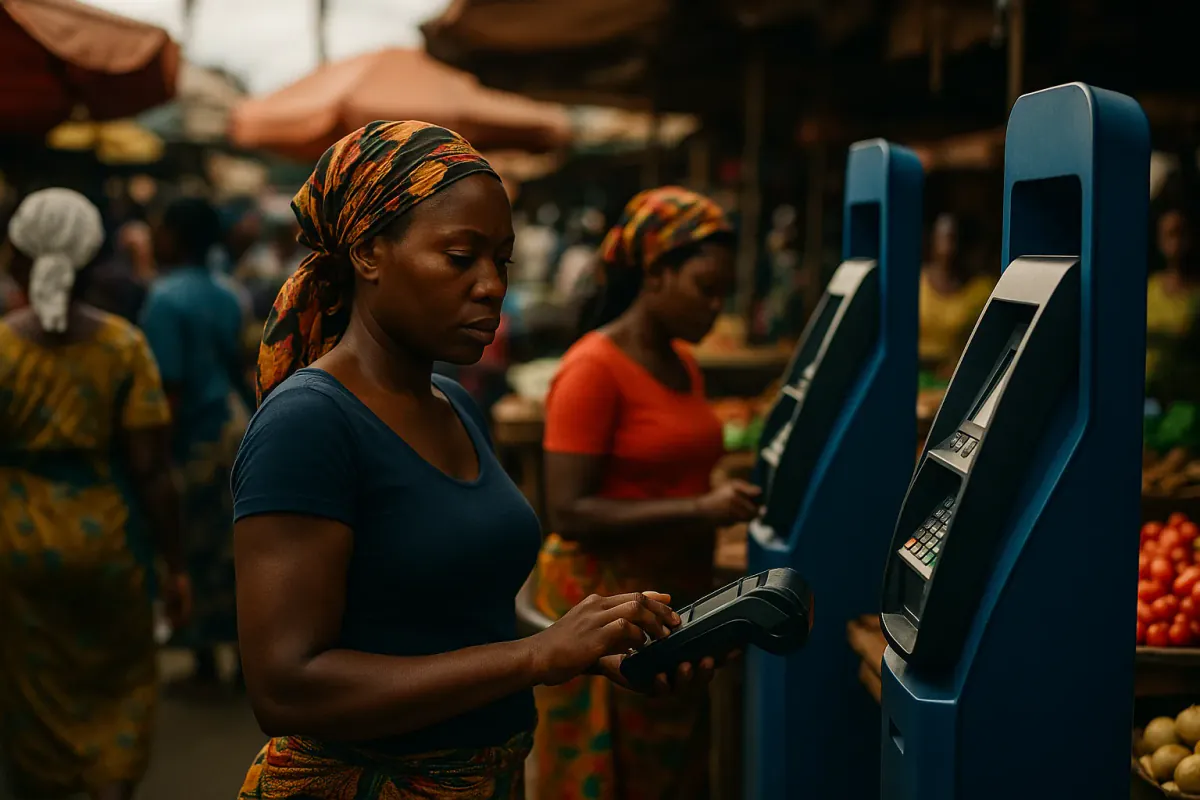
Africa Pioneers Mobile Money Interoperability
On September 29, 2026, PYMNTS reported that Citi had rewired its cross-border payments through a single SWIFT connection — one pipe, many corridors. The same day, SWIFT said it would link Bizum, PayID and Pix aliases so that a Spanish phone number can find an Australian or Brazilian one. Less noticed, and arguably more consequential, is what mobile money interoperability has already done inside Africa. According to the World Bank, 80% of African adults now have access to digital financial services, largely via mobile solutions.
That number matters because it was built on rails that predate the current wave of bank-led plumbing. Mobile money interoperability lets a customer on one network send value to a customer on another without a bank account, a card, or a correspondent bank in between. The sender dials a code, the recipient gets a text, and settlement happens in the background between operators. For millions of people who have never held a formal account, that is the difference between cash under a mattress and money that can be moved, saved and borrowed against.
How Interoperability Transformed Africa
Kenya, Tanzania and Nigeria did the unglamorous work first: they forced competing operators to talk to each other. Once a Safaricom wallet could reach an Airtel wallet, the network effect stopped belonging to one company and started belonging to the market. Intra-African trade felt it immediately. A trader in Kampala paying a supplier in Nairobi no longer needed a bank draft, a bureau de change, or three days of waiting.
According to PYMNTS reporting on Citi's single-connection model, interoperable operations cut transaction times from several days to minutes. Africa got there on lower budgets and older handsets, which is precisely why the model travels well.
The cost side is where the arithmetic gets interesting. A remittance of $200 sent through a traditional correspondent chain can lose 6% to 8% in fees and FX spreads before it lands. On an interoperable mobile rail, the same transfer can clear for a fraction of that, often under 2%. For a family receiving $200 a month, the saving is roughly $100 a year — school fees, medicine, a roof repair. Multiply that across a corridor and you are no longer talking about convenience. You are talking about household capital formation.
Challenges in Expanding to Other Regions
Exporting the African model is harder than copying it. Existing infrastructures elsewhere are built around cards and bank accounts, and incumbents have little incentive to let a phone number route around them. Local regulations differ on who may hold float, how customer funds are ring-fenced, and what counts as a licensed deposit. Add the perceived risk of mobile financial systems — fraud, SIM-swap, agent liquidity — and adoption slows.
Then there is the settlement question. Africa's operators solved it with bilateral arrangements and central bank oversight. A region without that shared plumbing ends up with interoperability in name only: instant on the front end, slow and expensive on the back end. The Federal Reserve's September 29 release of resolution plan feedback letters for 15 banking organizations shows how seriously large institutions are now treating the operational side of money movement, though it says nothing directly about mobile wallets.
Still, Africa's successes have given other regions a template. The Bank for International Settlements has pointed to the continent as proof that these systems can be secure and effective when supervision keeps pace with volume.
Economic and Social Impact
Cheaper transfers change behaviour. When the fee on a $20 transfer falls from $2 to $0.20, people stop hoarding cash and start using the wallet as a savings account. That is what happened in East Africa, and it is why mobile money interoperability has become a credit story as much as a payments story: transaction history becomes collateral.
Africa shows that mobile money interoperability is not just possible; it is essential for global financial inclusion.
The macro effect is slower but real. Lower friction between neighbours supports intra-African trade, which remains far below its potential. It also pulls informal flows into regulated channels, giving central banks visibility they never had over cash crossing borders in pockets and buses.
What this means for you
- Simplified international transfers: Interoperability allows expats to send money home more easily and affordably.
- Expanded access to financial services: Users can now access a wider range of financial services, including savings and loans.
- Reduced costs: Lower transaction fees mean more savings for users in their daily lives.
If you send money across currencies, the practical test is simple. Ask what the recipient actually receives, not what the headline fee says. A $500 transfer priced at "zero fee" with a 4% FX margin costs $20; the same transfer at a 1% margin costs $5. That $15 gap, repeated monthly, is $180 a year — real money for the person on the other end.
For more about the benefits of mobile money, explore our comprehensive guide.
According to the Federal Reserve's resolution plan feedback letters, supervisors are pressing large banks on how they would unwind complex payment obligations in a crisis — a reminder that speed and resilience have to be designed together. Regulators who understand that tend to write fintech-friendly rules.
The Next Step: Global Adoption?
Africa leads, but leadership is not the same as permanence. The question is whether other regions will follow and how much that would change the economics of moving money globally. The proven effectiveness of mobile money interoperability in Africa is a strong signal for global markets, and the infrastructure being laid elsewhere — single connections, alias directories, tokenized funds — suggests the pieces are converging.
It remains to be seen which global platforms will adopt this interoperability model across borders first. Whoever does will inherit a market that has already been taught, by African operators, that the phone number is the account.
Learn more about secure international transfers.