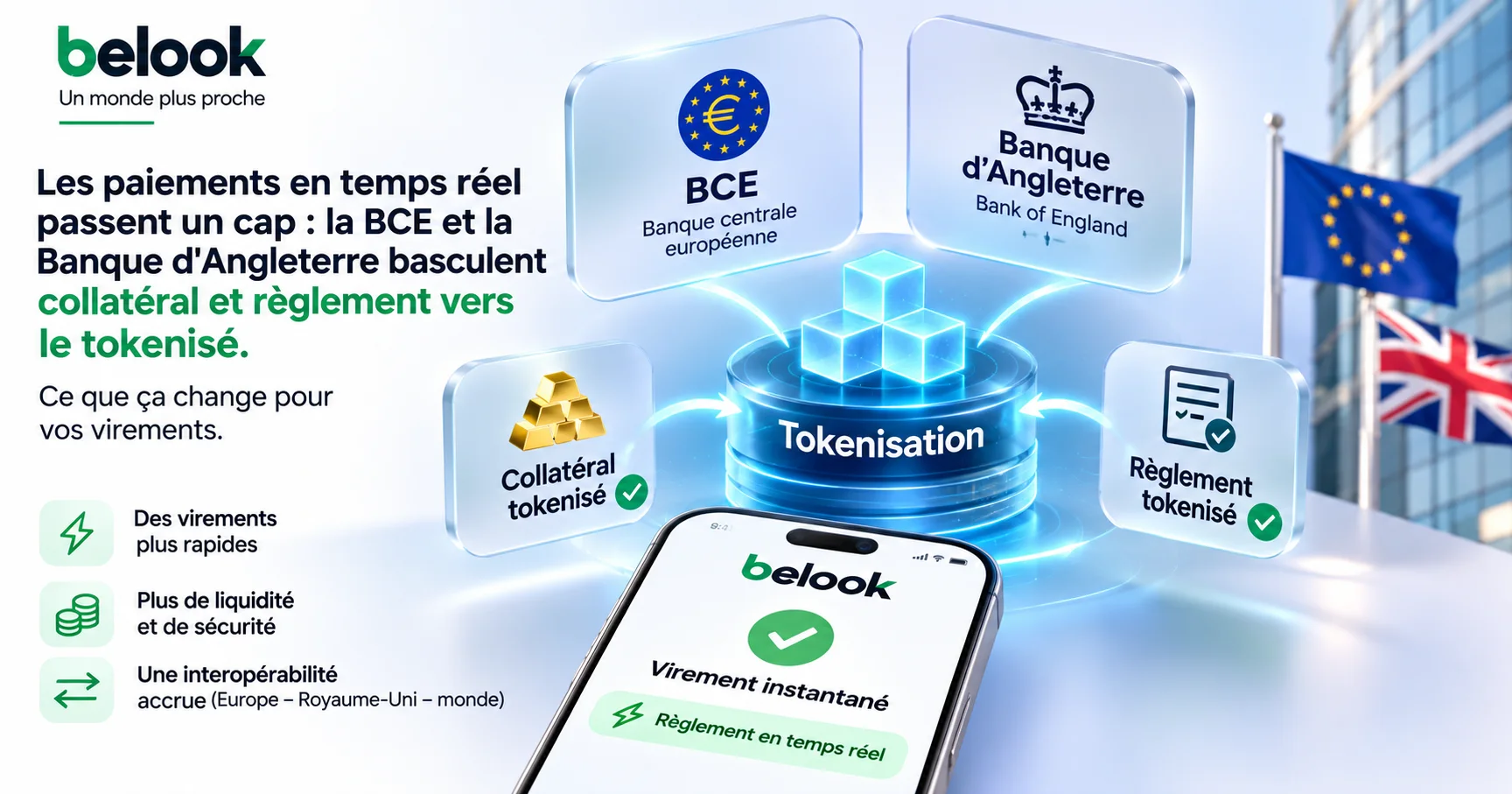
On 29 October, two central banks talked about the same subject on the same day, without coordinating. In Frankfurt, Piero Cipollone, a member of the ECB's executive board, described next-day securities settlement built on tokenisation. In London, the Bank of England published its doctrine on tokenised collateral in central clearing. Two technical texts, no dramatic press release. Yet this is the week the payments plumbing quietly changed sides.
The argument over real-time payments is no longer about how fast a transfer moves. For a decade the question was: how many seconds to credit an account? That's settled on most domestic corridors. The new question is: which money, backed by which asset, travels those rails at the speed of a second?
Real-time payments: speed is no longer the story
The ECB's timetable, set out by Piero Cipollone, explicitly ties the move to next-day settlement (T+1) to the transformation of Europe's financial infrastructure. In plain terms: the industry is no longer just compressing payment delays, it's compressing the settlement of the securities used as collateral. The Bank of England is moving the same way by setting rules for tokenised collateral in central clearing, per its approach published on 29 October.
That shift has a consequence few commentators pick up: real time stops being a service offered to end clients and becomes a constraint imposed on the whole chain. If collateral moves by the second, a corporate treasurer running liquidity across a multi-currency account has to think in continuous flows, not end-of-day balances. Belook's multi-currency account dossier already reflects that logic on the user side: several currencies, one readable balance, immediate movement.
The mechanism matters because of who ends up paying for it. When a bank has to post collateral overnight, it borrows to do so, and that borrowing cost is priced into the fee it charges the client. Squeeze the settlement window from a day to hours and the buffer shrinks, but the investment in new systems rises. Expect the savings to show up first in large institutional flows, and only later, if at all, in the price a small exporter pays to receive euros from a customer abroad.
European securities settlement is moving to T+1, a deadline the ECB ties directly to tokenised infrastructure.Tokenised collateral is the real engine
Why are central banks interested now? Because collateral has always been the choke point. A guarantee that takes a day to change hands ties up capital and forces firms to over-size their liquidity buffers. Tokenising that asset makes it divisible, transferable within minutes, and verifiable by code.
Run the arithmetic on a modest book. A firm posting €100m of collateral that can be released half a day earlier frees up capital it would otherwise have to fund at market rates. At a 3% funding cost, half a day on €100m is worth roughly €4,000. Multiply that across a clearing member's daily flows and the annual figure becomes material. That's the quiet economics behind the ECB's and the Bank of England's papers: not faster shopping, cheaper funding.
The shift goes beyond Europe. The Federal Reserve approved an application from The Bank of Nova Scotia on 29 October, a reminder that access to settlement infrastructure remains a closely supervised privilege, as the Fed's order shows. The rails are moving, but the gates are still guarded.
For ordinary users, the same machinery shows up in plainer clothes. Airtm and BVNK have partnered to let stablecoin wallet holders pay at retailers, according to Fintechnews Europe. A wallet that settles at the till is consumer-grade real time built on a tokenised asset. The central banker and the shopper are looking at the same plumbing, at two different scales.
The other half of the world is still offline
It has to be said, though: this acceleration only benefits the connected. The GSMA published a finding on 29 October that dampens the enthusiasm: in Gabon, more than half the population has no mobile internet access, even where network coverage exists, according to the GSMA's analysis. The barrier isn't the mast, it's the price of the handset.
That is the blind spot in the real-time payments conversation. Institutions keep perfecting settlement while millions of people lack the device that would give them access to the rail. A transfer that lands in three seconds is useless if the recipient has no smartphone. The Financial Inclusion Compass 2026 makes a similar point, describing increasingly hard trade-offs for the sector, according to NextBillion.
An ultra-fast rail that only serves the connected half of the world isn't infrastructure: it's a privilege.
What this means for you
- Judge international transfers on settlement, not on what the screen shows. Ask your provider when funds are genuinely available and what asset backs them, not just how many seconds the app displays.
- A multi-currency account becomes a treasury tool, not just a wallet. With rails moving continuously, holding several currencies in one account and converting at the right moment changes the real cost of a transaction. Belook's exchange service works on that basis.
- Be wary of "real time" claims that skip the counterparty. A stablecoin issued by an unsupervised player is still an asset, not a settlement guarantee.
The next date to watch
The question to follow isn't technological, it's a matter of calendar. The ECB has set the T+1 course and the Bank of England has opened the tokenised-collateral path; the test now is whether European market infrastructures publish their specifications before the end of the year, and whether consumer corridors follow with the same rigour.
Watch the sequencing, too. If tokenised collateral clears through central banks first, the benefit lands with clearing members before it reaches anyone sending money to a relative abroad. That's how the last round of payment reform worked, and there's no sign this one will break the pattern. The infrastructure gets faster at the top, then the price falls slowly downward.
Until then, hold on to one figure: more than half of Gabon's population is off mobile internet despite coverage. As long as that ratio stands, real time will remain a two-speed promise.
Sources
- ECB Press — Piero Cipollone: Next-day securities settlement, tokenisation and the transformation of Europe’s financial infrastructure (29 October 2026)
- Federal Reserve — Federal Reserve Board announces approval of application by The Bank of Nova Scotia (29 October 2026)
- Fintechnews Europe — Airtm and BVNK Partner to Let Wallet Users Pay at Retailers (30 October 2026)
- GSMA — GSMA Calls for More Affordable Smartphones as Over Half of Gabon’s Population Remains Off Mobile Internet Despite Network Coverage (29 October 2026)
- NextBillion — Harder Choices Ahead: What the Financial Inclusion Compass 2026 Tells us About the Sector’s Shifting Challenges (26 October 2026)